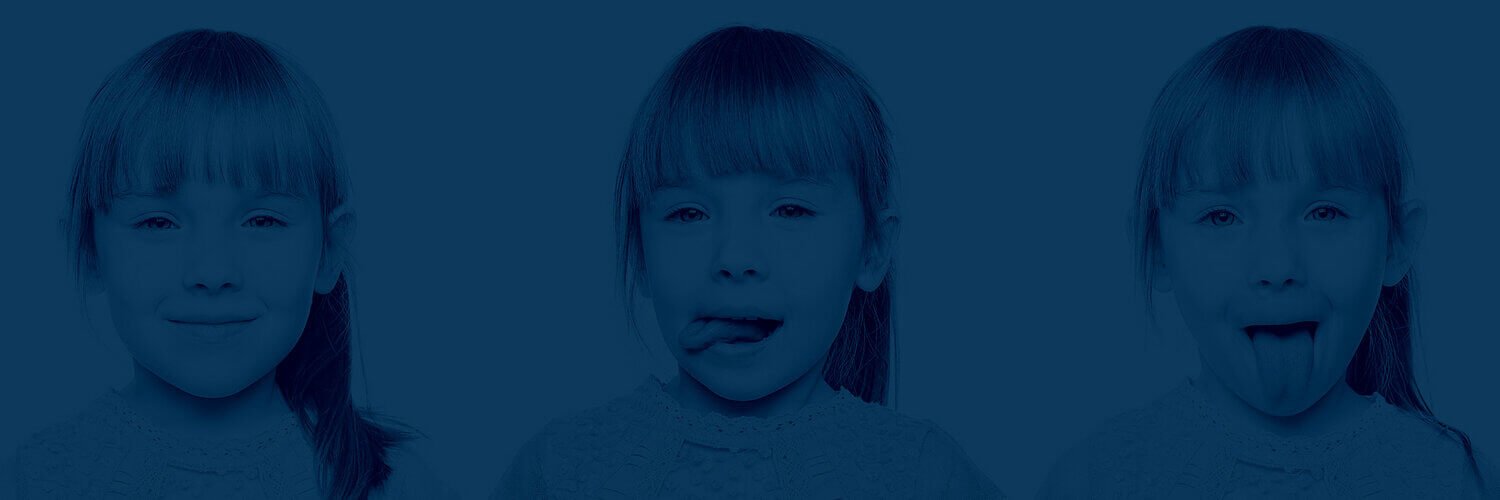
Lisp Therapy for texas kids
Virtual & Effective
Does Your Child Have a Lisp?
Clear, Confident S Sounds — From Home
A lisp doesn't have to be permanent. With the right approach and the right timing, most children make excellent progress — and virtual therapy works just as well as in-person for lisp treatment.
CloudSpeech offers specialized virtual lisp therapy for children ages 5 and up across Texas.
What Is a Lisp?
A lisp is a speech sound disorder that affects how a child produces the /s/ and /z/ sounds — the result of incorrect tongue placement, airflow, or both.
Lisps are one of the most common speech concerns parents raise — and one of the most treatable. Most children who receive targeted therapy make significant, lasting progress.
The Four Types of Lisp
Understanding which type of lisp your child has matters — because each type has a different prognosis, treatment timeline, and level of urgency.
Frontal (Interdental) Lisp The tongue protrudes between or toward the front teeth during /s/ and /z/, producing a "th" sound instead. "Sun" sounds like "thun."
This is the most common type and is developmentally normal in children under 4;6. If it persists past age 4;6–5, evaluation is recommended.
Dental (Dentalized) Lisp The tongue pushes against the back of the front teeth rather than resting just behind them. The /s/ sounds muffled or dull rather than crisp.
Like the frontal lisp, mild dentalized lisps may resolve naturally in young children. Persistence past age 5 warrants evaluation.
Lateral Lisp Air escapes over the sides of the tongue instead of flowing down the middle. The result is a "slushy," "wet," or "spitty" sounding /s/ and /z/.
Lateral lisps are not part of normal development and do not resolve without intervention. Evaluation and treatment are recommended regardless of age.
Palatal Lisp The tongue makes contact with the soft palate during /s/ and /z/ production, creating a distorted sound often described as resembling a /hy/ quality.
Like lateral lisps, palatal lisps are not part of normal development and require therapeutic intervention. Earlier treatment leads to better outcomes.
When Should My Child Be Evaluated?
Refer for evaluation if your child:
✔ Has a frontal or dental lisp persisting past age 5
✔ Has a lateral or palatal lisp at any age
✔ Is school-age and being teased or avoiding speaking situations because of their lisp
✔ Has tried to self-correct without success
✔ Has had previous therapy for a lisp without sufficient progress

Why Treat a Lisp?
Lisps primarily affect /s/ and /z/ — two of the most frequently occurring sounds in English. They don't typically affect overall intelligibility the way phonological disorders do, but research documents meaningful social and emotional impact even for children with mild, isolated errors.
Social confidence. School-age children are acutely aware of how they sound. Lisps that go untreated through middle school can affect willingness to speak in class, read aloud, and participate in social interactions.
Motor learning. The longer an incorrect pattern is practiced, the more automatic it becomes. Earlier treatment means a shorter treatment course and less established incorrect habits to override.
Lateral and palatal lisps don't self-correct. Unlike frontal lisps that may resolve developmentally, lateral and palatal lisps require direct intervention at any age.
How CloudSpeech Treats Lisps
Lisp therapy at CloudSpeech is:
✔ One-on-one — every session with Christina Burnham, MS CCC-SLP
✔ Evidence-based — phonetic placement approaches, auditory discrimination training, structured motor practice hierarchy from sound to conversation
✔ Virtual — teletherapy works especially well for lisp therapy because visual modeling is clear and feedback is immediate
✔ Efficient — focused 30-minute sessions with high repetition for faster motor learning
✔ Parent-supported — home practice guidance after every session to reinforce gains between appointments