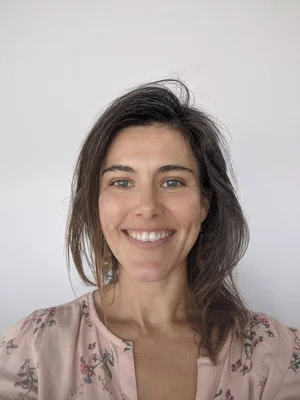
I Sold My Car, Moved to the Jungle, and Built a Speech Therapy Practice. Here's What That Has to Do With Your Child's Sessions.
I don't own a television. I don't wear a smart watch. I don't have a microwave.
I wash my face with coconut oil. I cook everything from scratch. I eat organic. I garden.
And I built my entire career on delivering therapy through a screen.
If that sounds contradictory, I want to explain. Because I think it says something important about why virtual speech therapy works — and who it's actually for.
How I Got Here
I started my career as a speech-language pathologist in the public schools of Houston — a Title I district, inner city, kids who needed everything and had very little.
I poured myself into that work. I brought real pumpkins to therapy sessions. I set up tents. I finger painted. I worked with high sensory-seeking kids with autism who needed to touch and move and feel everything around them.
I loved those kids.
And I burned out completely.
So I did something that made no sense to most people who knew me.
I sold my car. I bought a ticket to Costa Rica. I moved to the jungle.
For the better part of a year — traveling back and forth, maintaining my Texas roots and my Texas license — I washed my clothes in a bucket. I stopped wearing shoes. I was the first person on the beach in Santa Teresa almost every morning at sunrise. I walked a mile down the shore to the farmers market every Saturday to carry back my groceries for the week.
I was living as simply and as close to the natural world as I ever had.
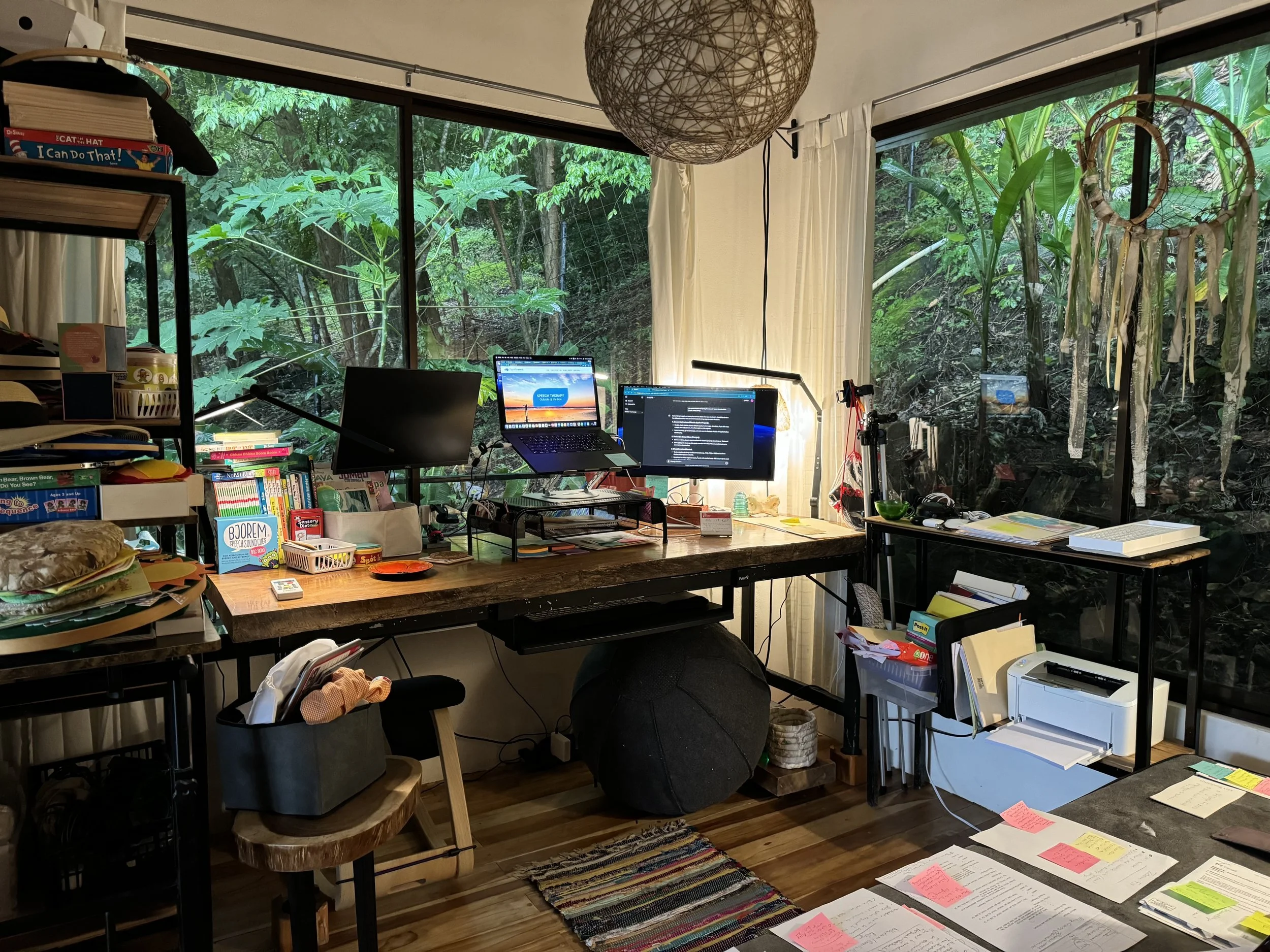
And I had my laptop.
The Idea That Changed Everything
Here's the thing I want to be honest about: when I first heard about teletherapy, I thought it was a terrible idea.
I was the SLP who brought actual pumpkins to sessions. The idea of trying to replicate the tactile, sensory-rich, hands-on work I did with young children — through a screen — seemed absurd to me.
But then I realized something.
The children I had burned out serving were still out there. And I was living somewhere that made me well enough to serve them.
What if I didn't have to choose?
What if the screen wasn't a barrier — but a bridge?
I started CloudSpeech from that place. Not from a clinic. Not from a business plan. From a jungle, on a laptop, with a Texas license and an intention to do meaningful work without destroying myself in the process.
Teletherapy gave me that. A Texas SLP, serving Texas families, working from wherever life had taken me. No clinic overhead. No commute. No geography limiting who I could reach.
The Boy on WhatsApp

Shortly after I arrived in Costa Rica, I met a family staying next door to where I was living.
Their grandson was six years old. He barely spoke.
He was smart — you could see it in his eyes — but words weren't coming the way they should.
His local school had a speech therapist who told his family they weren't allowed to diagnose Childhood Apraxia of Speech. They weren't sure what to do next.
I sat with him. I watched him try to talk. I knew immediately what I was looking at.
I offered to work with him.
We didn't have a sophisticated platform. We used WhatsApp. On our phones. Once a week.
And he started making progress.
To this day I continue to provide his weekly sessions in Spanish, supporting his diagnosis of Childhood Apraxia of Speech and expressive language disorder.
He taught me what is actually possible through a screen.
That boy is still my client today. He is one of the reasons I kept going during the hardest moments of building this practice — when I wasn't sure it was worth it, when the tech wasn't cooperating, when I doubted whether I had something real to offer.
What My Choices Have to Do With Yours
I think about my own life a lot when I think about my clients' families.
I chose to leave the city because the commute and the pace were costing me more than I was earning. Not financially — in every other way.
The families I work with in Texas are making similar calculations every week.
A child who needs speech therapy two or three times a week for meaningful progress — which is what the research supports for most speech sound disorders — is asking a family to find two or three open windows in their schedule, load everyone in the car, drive to a clinic, wait, do the session, drive home, and somehow still make dinner and help with homework and get everyone to bed on time.
For families in Austin or Houston, that's traffic. For families in Midland or Nacogdoches or Gonzales, that's distance. For most families, it means therapy happens once a week instead of twice — not because they don't care, but because twice simply isn't possible.
I believe that access to consistent, high-frequency specialist care should not depend on geography or a family's ability to spend eight hours a week in the car.
Virtual therapy doesn't solve everything. But for the right child and the right family, it removes the barriers that make consistent therapy impossible.
And consistent therapy is where progress actually lives.
This Isn't About Screens
I want to be direct about something.
The parents I work with are thoughtful people. Many of them are already thinking carefully about technology in their children's lives. They're asking the same questions I ask: What does my child actually need from the time they spend on a screen?
I don't own a TV. I limit my own screen time deliberately. I have to make an effort to check my phone.
And I chose teletherapy.
Not because I love screens — but because I thought carefully about what a screen can and cannot do, and I concluded that for the right client, a focused, one-on-one session with a specialist who is watching every sound your child makes and adjusting in real time is not passive screen consumption.
It is the opposite of that.
Thirty minutes of YouTube and thirty minutes of speech therapy that happens to use a screen are not the same thing.
One is screen time. The other is therapy.
What About AI Apps and Home Practice Tools?
This is something I want to address directly, because there are now dozens of apps and AI-powered tools marketed to parents as supplements to — or substitutes for — speech therapy.
Some are useful for home practice. I assign home practice every week. Repetition between sessions matters.
But an app cannot do what a trained clinician does in real time. It cannot identify the specific motor pattern causing your child's error. It cannot adjust its approach based on what it hears in that exact moment. It cannot build the relationship that makes a child willing to try the hard thing one more time.
Teletherapy isn't a bridge to an app. It IS the therapy — delivered through a screen, by a real clinician, in real time.
Is Virtual Speech Therapy Right
for Every Child?
No. I'll be honest about that.
In-person speech therapy is excellent, and for many children it is the right fit. I recommend it when it makes sense. This is not an argument against it.
But for the children I work with — school-age kids ages 5 and up with speech sound disorders — teletherapy is not a compromise.
For the right child, it is genuinely the better option.
They're old enough to engage through a screen. They're motivated to fix something that is affecting them socially. They have the ability to self-monitor with guidance.
And the convenience of teletherapy means they can attend at the frequency that actually produces results — instead of the frequency their family's schedule allows.
The Bottom Line
I moved to the jungle because I needed to find a way to keep doing this work without losing myself in the process.

Teletherapy made that possible.
And in doing so, it also made something possible for the families I serve: consistent, high-frequency, specialist-level care — from home, on a schedule that fits their actual life.
Screen time worth limiting looks like passive consumption with nothing coming back.
Speech therapy that happens to use a screen looks like a child in their favorite chair, working hard, making progress, and eating dinner with their family at the end of the night because nobody spent two hours in the car.
That's not screen time. That's therapy. And it's the best version of this work I have ever done.
Wondering if CloudSpeech is the right fit for your child?
Book a free parent consultation →
We'll talk through your child's history, what you've tried, and what progress could realistically look like. No pressure. No commitment.
Christina Burnham, MS CCC-SLP Founder, CloudSpeech Online Therapy cloudspeech.com | 512-765-4554